The San Fermín Chupinazo is the instant when Pamplona changes rhythm. Every 6 July at 12:00, City Hall Square gathers an anticipation that is hard to compare with any other festival moment: thousands of red scarves are raised, the crowd looks towards City Hall and a rocket marks the official beginning of San Fermín. It is not simply a time in the programme. It is a collective agreement: for a few seconds the city holds its breath, and when the fuse is lit, a celebration begins that will fill streets, squares and conversations in the days that follow.
For first-time visitors, the Chupinazo can look like a familiar television image. Experiencing it with context changes that perception. The place, the shared language, the gesture of tying the scarf and the mix of residents and visitors all matter. Together they turn the square into an unrepeatable scene. This guide explains what the Chupinazo is, where and when it takes place, how it evolved and what is useful to understand before coming to Pamplona on 6 July.
What is the San Fermín Chupinazo?
The Chupinazo is the rocket launch that announces the official start of the San Fermín festival. It takes place from the balcony of Pamplona City Hall, facing City Hall Square. Before lighting the fuse, the person responsible for the launch gives the traditional greeting to the square in Spanish and Basque. The rocket’s burst then gives way to a collective reaction of joy, embraces, songs and red scarves tied around people’s necks.
Its strength does not depend only on the number of people in the square. The Chupinazo brings together several San Fermín symbols in one simple gesture: waiting, white and red clothing, popular participation, the relationship between City Hall and the street, and the feeling that the city will now operate differently. It is therefore one of the essential moments of any San Fermín guide. It shows that the festival is not a series of isolated spectacles, but a shared tradition with many layers.
The event has become an international image, yet it remains deeply local in scale. The square fills with familiar voices, groups of friends, families and people returning year after year. At the same time, it welcomes people discovering it for the first time. This coexistence of memory and curiosity is one reason the Pamplona Chupinazo retains such intensity.
When, where and at what time does it take place?
The Chupinazo has a fixed date: 6 July. The rocket is launched at 12:00 midday from City Hall, in Pamplona’s City Hall Square. It is useful to arrive with this reference in mind, but it should not become a promise of a particular route or access. The surrounding area changes rhythm as the time approaches, and the official guidance for each edition is the best source for planning the day.
City Hall Square lies in the heart of Pamplona’s old town, among streets that form part of the city’s daily life. During San Fermín, the space takes on a different dimension. The physical closeness of balconies, façades and square concentrates the sound, making the rocket feel like a visible starting point for the whole city.
City Council publishes practical information and updated recommendations for each edition. For current details on date, time, location and institutional context, always consult the official Pamplona Chupinazo page, especially when travelling from outside the city or following the programme beyond the opening event.
The history of the Chupinazo: from 1931 to City Hall’s balcony
The modern Chupinazo has a popular origin. The earliest references collected by the City Council date to 1931 and link the rocket launch to Juan Etxepare, a tobacconist on Calle Mayor, who asked permission to set off rockets in the street at midday on 6 July. The origin is revealing: before becoming a ceremony watched around the world, it was a close-to-home initiative born from the wish to announce that the festival had begun.
In its early years, the rockets announcing the festival were launched from Plaza del Castillo. The move to City Hall’s balcony came in 1941. From then on, City Hall Square became the recognisable Chupinazo setting, and the event developed the institutional and collective character it retains today.
Knowing this evolution gives the moment greater depth. The Chupinazo did not appear from nowhere; it is the result of decades of custom, adaptation and civic participation. The way its launcher is chosen has also changed. Since 2016, Pamplona has used a participatory process and public vote among candidates proposed by city associations. The idea remains important: although the rocket is launched from the balcony, the festival also belongs to the square and its communities.
What happens just before 12:00?
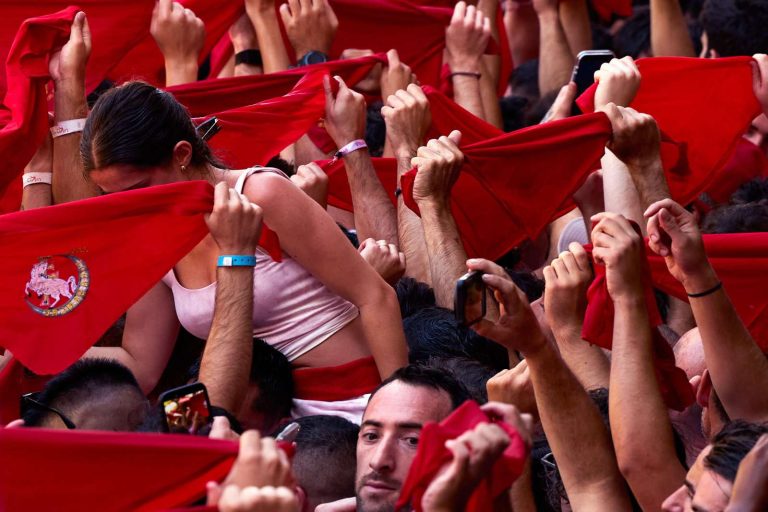
The minutes beforehand explain much of the emotion. Shortly before midday, the square is already given over to waiting. Red scarves are not yet tied around necks: they are held high as a shared sign of anticipation. The white clothes and red scarves create an image repeated every year, but never identical because the people, voices and atmosphere change.
When the person launching the rocket appears, a relative silence emerges from the background noise. The ritual greeting arrives, followed by an informal countdown and the moment of the fuse. After the Chupinazo, everyone experiences the first minute differently: some embrace their group of friends, some seek a street in which to continue the day, and some simply pause to watch Pamplona fill with movement.
There is no need to treat the event as a competition to stand at the centre of the image. The experience can also mean watching the old town transform, listening to the first songs or moving calmly through the atmosphere afterwards. That attentive view connects the Chupinazo with Pamplona’s local culture and everyday life beyond a single photograph.
The red scarf and the festival’s symbolic beginning
The red scarf is one of San Fermín’s most visible signs, but it takes on a special meaning during the Chupinazo. Before 12:00 it is held high; after the rocket, it is tied around the neck. The gesture marks the transition from waiting to festival. It is not an empty rule or an accessory without context: it is shared language that identifies the official opening of the festive cycle.
The white and red colours do not tell San Fermín’s whole story, but they offer a useful point of entry. From there, visitors can discover other rituals, peña music, Giants and Bigheads, religious events and street life. Understanding the scarf’s origin and use helps place a familiar gesture within a shared tradition.
How to experience the Chupinazo with respect and context
The Chupinazo brings together a very large number of people in one specific space. The best preparation is not to imagine an identical experience for everyone, but to pay attention to the surroundings and the guidance for each edition. Coexistence matters: respecting participants, following public recommendations and understanding that the centre of the square has its own intensity are part of understanding the event.
It is also useful to separate the desire to “see everything” from the real experience of being there. San Fermín is better understood when there is room to observe. The official opening continues after the rocket in streets, squares and conversations; it does not end when the first minute’s noise fades. A calmer view makes it possible to appreciate the architecture of City Hall Square, the role of groups of friends and the contrast between institutional ritual and popular response.
For some people, an elevated view or a quieter observation point may offer another reading of the square. It does not replace being at street level or guarantee a single way of experiencing the event; it simply provides another distance from which to observe the crowd, the balcony and the launch. Every visit depends on the edition, the group and current guidance.
The Chupinazo as a gateway to San Fermín
The 6 July rocket does not explain a festival as broad as San Fermín on its own, but it opens its story. The runs, the troupe, peñas, processions, meals, music and the daily rhythm of a city living its most intense days all follow. The Chupinazo helps place everything else: it is the first sign that Pamplona has entered San Fermín.
Looking at it through history avoids reducing it to a postcard. It is an event with a popular origin, an institutional dimension and an unusual capacity to bring a whole city together around one instant. That may be its real force: you do not need to know every detail to feel the energy of the square, but knowing them helps you experience it with greater respect and memory.
To complete that perspective, it is useful to discover Pobre de mí, the event that closes the cycle on 14 July and turns the same square into a farewell of candles and voices.
Frequently asked questions about the San Fermín Chupinazo
What time is the San Fermín Chupinazo?
The Chupinazo takes place on 6 July at 12:00 midday. The rocket is launched from Pamplona City Hall’s balcony in City Hall Square.
Where is the Chupinazo held in Pamplona?
The event takes place in City Hall Square, in front of Pamplona City Hall. It is one of the old town’s most symbolic places during the festival.
When do people put on the red scarf at San Fermín?
The tradition is to hold the scarf high before the rocket and tie it around the neck after the Chupinazo. The gesture signals the official beginning of the festival.
Since when has the Chupinazo been launched from City Hall?
Launching the rocket from City Hall’s balcony has been a tradition since 1941. Before then, rockets announcing the beginning of the festival were launched from Plaza del Castillo.
Who launches the San Fermín Chupinazo?
The person responsible changes each year. Pamplona City Council announces the process and designation for each edition; since 2016, the selection has included a participatory process among candidates proposed by civic associations.