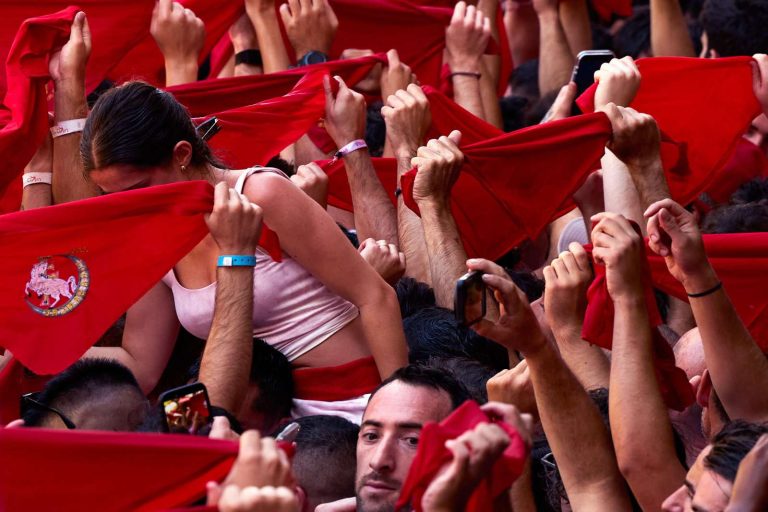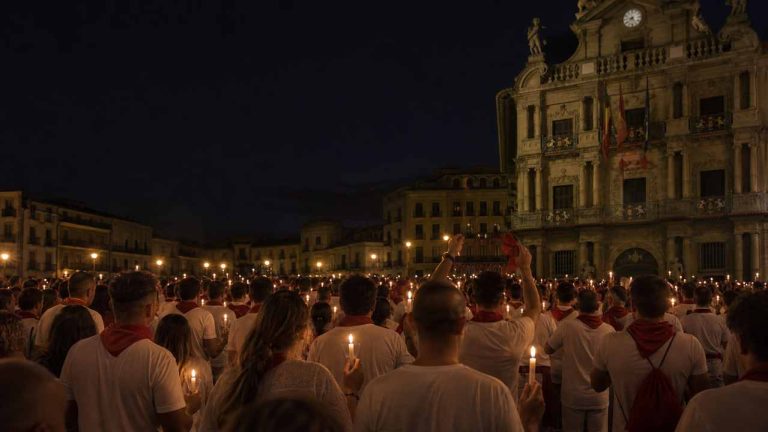
The San Fermín procession reveals a dimension of the festival that can be left out of its most widely circulated images. On 7 July, Pamplona accompanies the saint’s image in an event that brings together religious tradition, civic ceremony, music and popular participation. You do not have to share the same spiritual experience to recognise its cultural weight: the procession helps explain why the festival bears San Fermín’s name and how institutional, family and festive life coexist within it.
For visitors, this moment can provide a revealing contrast. After the crowded opening of the festival, the pace changes. Attention settles differently on the image, its accompanying groups and the streets along which the procession passes. Watching respectfully shows that San Fermín is not explained only through high-intensity events; it is also built through recurring ceremonies, neighbourhood memory and symbols still present in Pamplona’s life.
What does the San Fermín procession commemorate?
The procession is held on 7 July, the saint’s feast day. San Fermín is co-patron saint of Navarre alongside Saint Francis Xavier and a central figure in Pamplona’s tradition. Devotion, history and legend have intertwined for centuries; it is therefore useful to distinguish documented facts, popular traditions and the festival as it is experienced today.
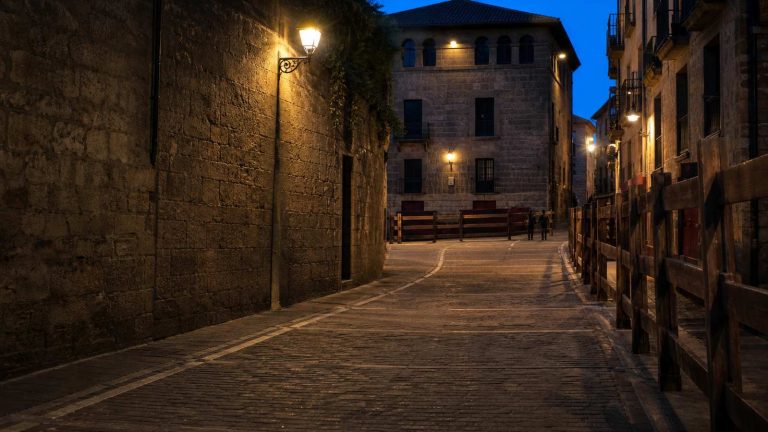
The processional image leaves the Church of San Lorenzo, home to the chapel dedicated to the saint. Pamplona City Council explains that the procession travels through the city in his honour and that this day remains especially significant within the San Fermín festivities. The event turns the historic centre into a ceremonial space, allowing its buildings, squares and streets to be seen from a different perspective.
It is not an isolated event. The troupe, music and other accompanying groups form part of the context of a morning with many meanings. Its exact format may change with the annual programme, so timetables, routes and access arrangements from previous editions should never be treated as fixed.
History, tradition and city
The procession connects with the religious origins of the festival. Over time, events in honour of the saint joined fairs and other celebrations to form the contemporary San Fermín festivities. That evolution helps explain the festival’s complexity: it does not come from a single custom, but from historical layers that have lived together and changed.
In the street, that history does not appear as an academic lesson. It is felt in simple gestures: families waiting for the procession, neighbours who know the route, accompanying music and visitors discovering that white and red are not the only language of the festival. The procession creates a pause and reminds us that Pamplona is not simply the setting for a festival; it is a city with its own heritage, community and memory.
It also calls for a respectful approach. The ceremony is not organised as an attraction. Observers should keep the route clear, follow instructions, avoid climbing unsafe places for photographs and respect silence when the occasion requires it. That attitude makes it possible to enjoy the event without interfering with a tradition that belongs first and foremost to the city.
How to experience the procession when visiting Pamplona
First, consult the official programme for the edition you plan to visit. The route and recommendations may vary. Arrive with time to spare, identify spacious areas and have an alternative plan if your chosen place is too crowded. If you are travelling with children or with people who prefer to avoid crowds, choose a street with more room and accept that being in the front row is not necessary to understand the event.
Observation matters more than capture. A photograph can be a memory, but it should not determine the whole experience. Listen to the music, watch how the street changes and notice the elements accompanying the procession. Afterwards, walking through the historic centre or visiting cultural spaces can extend that perspective. Culture and Pamplona contains further articles that help explain this urban context.
The San Fermín guide connects the procession with other July moments without confusing their different intentions. Each event follows a distinct rhythm: the opening, mornings with the troupe, the Running of the Bulls, street music or the final farewell. That diversity is precisely why San Fermín is difficult to reduce to a single image.
The Chapel of San Fermín and the historic centre
The Church of San Lorenzo and its chapel are essential points of reference. Knowing the place helps situate the procession in the city and understand why it begins there. The architecture, the saint’s image and its relationship with the surroundings are an important part of Pamplona’s cultural story.
There is no need to turn the visit into a rushed itinerary. It is better to choose a few places, walk slowly and notice the connections between streets. The procession travels through a historic centre that also speaks of markets, walls, neighbourhood life and heritage. After the event, the city returns to other rhythms and offers many opportunities to keep discovering its cultural dimension.
For a reliable external source, consult Pamplona City Council’s information on San Fermín. For dates, routes and operational measures, the only valid reference before travelling is the current official programme.
Frequently asked questions about the San Fermín procession
When is the San Fermín procession held?
It is held on 7 July, San Fermín’s feast day. Check the official programme for each edition for timetable and route details.
Where does the procession start?
Its departure is linked to the Church of San Lorenzo and the Chapel of San Fermín. Consult current municipal information for the precise route.
Do I need to be religious to attend?
No. It is a religious event, but also a cultural and civic tradition. It can be observed respectfully while recognising what it means to many people.
Do the Giants and Bigheads take part?
The troupe forms part of the day’s context and of several San Fermín events. The exact line-up for each edition is published in the official programme.
How can I watch the procession without causing disruption?
Arrive with time to spare, remain outside passageways, respect organisers’ instructions and avoid treating the ceremony as a setting in which to interrupt or block the street.