Pobre de mí is the official farewell to the San Fermín festival. On the night of 14 to 15 July, at 24:00, City Hall Square again becomes a meeting place, but its energy is different from that of the opening. Where the Chupinazo begins the festival with a rocket and an explosion of voices, Pobre de mí closes it with candles, a shared song and the removal of the red scarf. It is a moment of quiet emotion: Pamplona acknowledges that its intense days are ending while still looking towards the following summer.
For first-time visitors, the event may seem like a brief scene at the end of the programme. In fact, it contains many of the symbols that explain San Fermín: the square, popular participation, memory, music, white and red. Understanding Pobre de mí completes the festival’s story with a more human and local perspective. This guide explains what it is, when it takes place, what its gestures mean and how to approach it with respect and context.
What is Pobre de mí at San Fermín?
Pobre de mí is the last official event of the San Fermín festival. Thousands of people gather in front of Pamplona City Hall with lit candles to sing the traditional farewell. The atmosphere is not silent, but it is more contained than at other moments during the week: there is emotion, embraces, shared tiredness and a feeling of ending mixed with the promise of return.
The name comes from the popular song that accompanies the event and laments the end of the festivities. You do not need to know every verse to understand its meaning. Observe the collective gesture: a square lit by small flames, people who have worn white and red throughout San Fermín, and a ritual that recognises the city’s gradual return to its everyday rhythm.
Like other major festival moments, Pobre de mí has a public and an intimate dimension. It is public because it is held in an emblematic square and gathers a great many people. It is intimate because every person arrives with a different experience: the end of a journey, a week with friends, a family tradition or the memory of a first visit. That is why it has an essential place in any San Fermín guide.
When and where does Pobre de mí take place?
Pobre de mí is held on the night of 14 to 15 July, at 24:00. It can also be expressed as 00:00 on 15 July, but saying 24:00 on the 14th helps explain its purpose: it is the instant that ends the final official day of San Fermín.
The setting is City Hall Square, in front of Pamplona City Hall. The crowd gathers there with candles and red scarves to hear the closing from the balcony. It is the same square that hosts the Chupinazo on 6 July, creating a symbolic arc: one event opens San Fermín at midday and the other says goodbye at midnight.
Practical arrangements can vary by edition, so always check Pamplona City Council’s official Pobre de mí information for current guidance. The institutional source confirms the date, City Hall Square as the location and the event’s status as the official closing.
The meaning of the candles and red scarf
Candles are the image that defines Pobre de mí. Their light changes the meaning of the square: after a week of noise, music and movement, thousands of small flames create a slower atmosphere. This is not scenery detached from the city. It is a way of turning a shared space into a place of farewell.
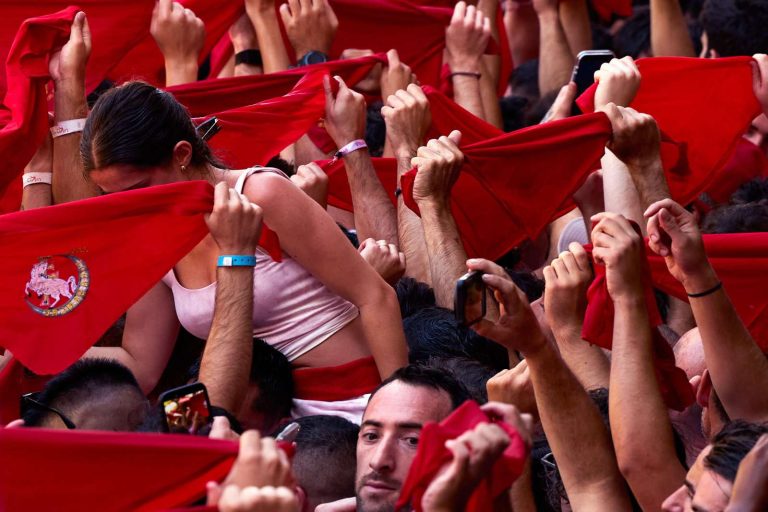
The red scarf completes that language. During San Fermín it is worn around the neck as a visible sign of participation. At Pobre de mí, many people remove it. The simple movement marks that the festival has officially ended. Removing the scarf does not erase what has been experienced; it turns it into memory and expectation for the following year.
The ritual connects the end with the beginning. At the Chupinazo, the scarf is held high before the rocket and tied around the neck when the festivities begin. At Pobre de mí, the gesture is reversed. This symmetry helps explain that San Fermín has its own cultural structure: it is not simply a succession of days, but a cycle with an opening, central moments and a farewell.
Candles, scarf and song do not demand one interpretation. Some people experience them through family tradition, others through the emotion of a journey, and others simply as a way of being present in the square. What matters is recognising them as shared symbols and treating them with the attention an event so cherished by the city deserves.
The farewell song and the official end of the festivities
The Pobre de mí song gives the event its name and concentrates its tone. It is sung collectively, by some voices clear and others tired, with a particular mixture of sadness and joy. It is not a solemn farewell in a strict sense. It is a close, popular goodbye: friends embrace, families find one another and the square recognises that the rhythm of recent days has come to an end.
From City Hall’s balcony, the close of the festival is announced. Pamplona then begins to recover its everyday pulse. That transition does not happen at once in every street, but the event gives the city a shared reference: the official programme has ended and the memory of San Fermín is kept until the next edition.
Anyone can join the song, listen or simply accompany the moment respectfully from a distance. It does not need to be turned into a spectacle. Sometimes it is enough to observe the candles, the sound moving across the square and the way white and red start to disappear. This is one of the perspectives most closely connected to Pamplona’s local culture and daily life.
From the Chupinazo to Pobre de mí: San Fermín’s two great symbols
The Chupinazo and Pobre de mí work as two ends of the same story. The first takes place at midday on 6 July and concentrates euphoria, expectation and movement. The second comes at the end of 14 July and speaks of farewell, tiredness and the wish to return. Between them unfolds the complexity of San Fermín: not only great crowds, but rituals, routes, music, encounters and a city changing rhythm.
This relationship prevents an incomplete view of the festivities. Looking only at the beginning leaves out the emotion of the end; looking only at the end prevents an understanding of the scarf, the square and the shared language. The Chupinazo explains how the cycle is lit, while Pobre de mí shows how it is said goodbye to.
Both events also reveal the role of City Hall Square. It is not simply a tourist backdrop. It is where the relationship between City Hall, the public and the festival is expressed. At one end appears the rocket; at the other, the candles. Between them, the square retains its architecture but changes meaning completely according to the hour, light and people who occupy it.
How to experience the event with respect and context
Pobre de mí brings many people together at a very emotional moment. Approaching it respectfully means understanding that it is neither an isolated celebration nor merely a night-time photograph. For many people, it is a farewell connected with memories, friendships and customs repeated for years.
Follow public guidance for each edition, pay attention to the space and avoid turning the square into a place of hurry. The event has its own cadence: people arrive, light candles, sing, say goodbye and gradually move through the old town’s streets. Leaving room for that rhythm helps make the experience more conscious.
An elevated view or a quieter observation point can offer another way of reading the scene: the whole field of lights, City Hall’s façade and the movement of the square become visible. It does not replace the street-level experience or guarantee the same event for everyone; it simply changes the frame. Any plan depends on the edition, the group and current guidance.
The best memory will not always be a perfect image. It may be a conversation afterwards, the relative silence of a nearby street or the feeling of Pamplona returning to its pace after the year’s most intense days. That unhurried perspective is a good way to extend the journey and understand the festival beyond its best-known moments.
A farewell that leaves the return open
Pobre de mí ends San Fermín, but it does not close its story entirely. When the candles go out and scarves are removed, the memory of what was shared remains, along with the next 6 July as a horizon. That ability to say goodbye without closing the desire to return is part of the event’s emotion.
Pamplona is not reduced to its festival, but San Fermín helps visitors understand many of its layers: the old town, rituals, voices and capacity to welcome those who arrive with curiosity. Pobre de mí invites a calmer view of all this. After euphoria, the city becomes everyday again and, for that reason, reveals another part of its identity.
Frequently asked questions about Pobre de mí at San Fermín
What time is Pobre de mí at San Fermín?
Pobre de mí is held at 24:00 on 14 July, meaning the midnight that leads into 15 July. It is the official close of the festivities.
Where is Pobre de mí held in Pamplona?
The main event takes place in City Hall Square, in front of Pamplona City Hall. The crowd gathers there with candles to hear the closing from the balcony.
Why do people remove the red scarf at Pobre de mí?
Removing the red scarf symbolises that San Fermín has officially ended. It is the reverse of the Chupinazo gesture, when the scarf is tied around the neck at the beginning of the festival.
What do the Pobre de mí candles mean?
The candles create a collective image of farewell and accompany the popular song. Their light turns City Hall Square into a space of quieter emotion at the end of the festival.
Is Pobre de mí the last official event of San Fermín?
Yes. Pamplona City Council identifies it as the event that officially ends the San Fermín festival before the next edition.