The San Fermín Running of the Bulls defines Pamplona’s festival mornings. Each day brings together tradition, the city, a shared sense of anticipation and an exceptionally demanding run. For visitors to the capital of Navarre, understanding what happens, when it starts and how the route is organised provides context and helps you prepare for the morning without mistaking the excitement for an invitation to take part.
The run takes six bulls and the steers from the Santo Domingo corrals to the bullring, through the old town. It is a scene known around the world, but it takes place on real streets, with residents, public services, access controls and rules that must be respected. This guide is intended primarily for people who want to watch the San Fermín Running of the Bulls in an informed, calm and responsible way.
When does the San Fermín Running of the Bulls take place?
The usual San Fermín Running of the Bulls calendar covers eight mornings, from 7 to 14 July. The start is at 8:00 am. The festival opens with the Chupinazo on 6 July, but there is no bull run that morning; the first run takes place the following day.
The starting time is not the time you should aim to arrive. The route is prepared in advance, checkpoints are established and access arrangements change before the run begins. Whether you plan to watch from the street, a balcony or another authorised viewpoint, always check the instructions for that year and allow plenty of time to get there.
The most useful source for checking information that may change, restrictions and annual notices is Pamplona City Council’s official information about the Running of the Bulls. Reading it before travelling helps you avoid relying on old schedules, videos from previous years or outdated advice.
The route: from Santo Domingo to the bullring
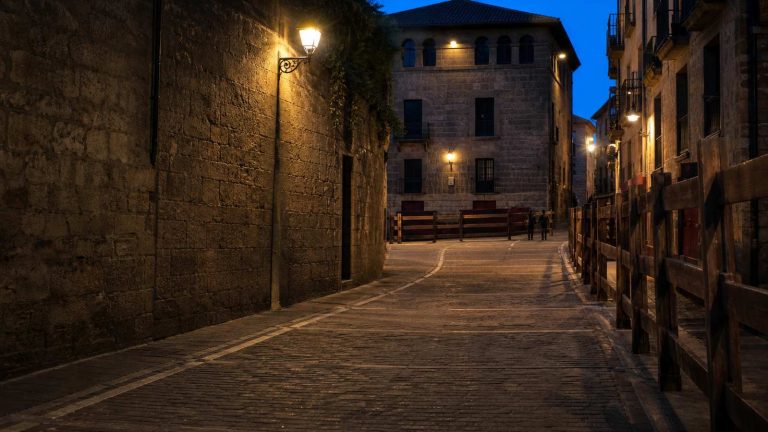
The route begins at the Santo Domingo corrals and passes through some of the most recognisable streets in Pamplona’s old town. The Santo Domingo slope leads to City Hall Square; from there, the run continues along Mercaderes and Estafeta, through the Telefónica section and into the narrow passage leading to the bullring.
Each section looks and feels different. The initial slope at Santo Domingo, the Mercaderes bend, the length of Estafeta and the final entry into the bullring explain why the same run produces such different images depending on where you watch it. A balcony, a barrier or a seat in the bullring offers a view of one part of the route, not the entire course.
A good way to understand the route without interfering with the event’s organisation is to walk it at another time. Outside closure hours, looking at distances, bends, narrow points and slopes turns familiar street names into a real geography. Taking time to explore gives the experience more meaning while respecting streets that are not simply a backdrop.
The barriers are an essential part of the safety arrangements and the organisation of the morning. They must not be crossed, tampered with or treated as a way to gain a better viewpoint. Signs and staff instructions are there to protect both participants and those watching from outside the route.
What happens before 8:00 am?
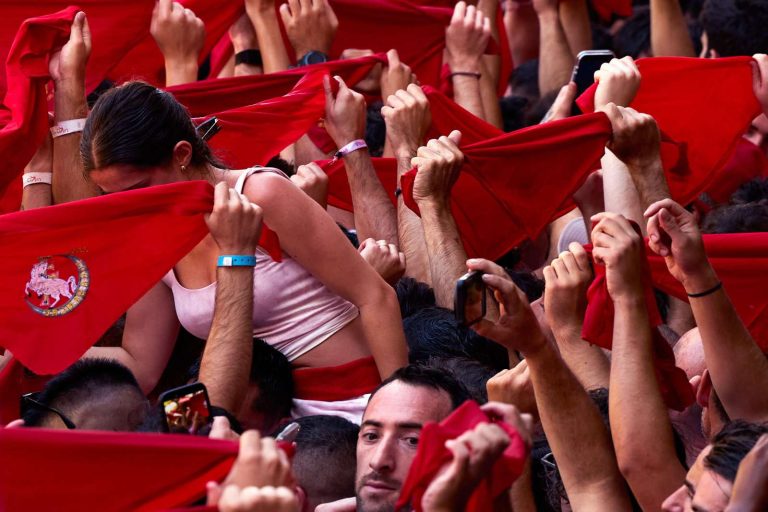
Before the starting rocket sounds, Pamplona is already organised around the route. Streets are prepared, access changes and the atmosphere brings together runners, residents, safety teams, journalists and spectators. For first-time visitors, this build-up can be as revealing as the run itself: it shows that the Running of the Bulls is not an isolated event, but a collective occasion requiring precise coordination.
On the Santo Domingo slope, runners sing to the saint before the start. It is one of the morning’s most recognisable rituals and part of the festival’s symbolic language. Watch without treating it merely as a scene to record: leaving space, following instructions and avoiding interruptions to people preparing to run are basic forms of respect.
If your aim is to watch, you do not need to position yourself where the tension is greatest. Choosing a viewpoint that helps you understand the event, arriving on time and remaining calm are usually more valuable than pursuing the closest possible image. The run lasts only a short time; the full experience begins much earlier and continues in the conversations about what you have seen.
How to watch the Running of the Bulls with context and responsibility
There are different ways to follow the Running of the Bulls. At street level, visibility and access depend on the section and the instructions in place. A balcony gives an elevated view of a particular area; before making an enquiry, it makes sense to ask about the section, meeting time, visibility and applicable conditions. From the bullring, you watch the final arrival, which has a different rhythm from the streets.
On the Running of the Bulls balconies page, you can share your date and group size to receive personal guidance. An enquiry does not itself confirm a reservation or assume availability: it allows a proposal to be considered using specific information, without premature promises.
Watching responsibly also means accepting that not every image should be pursued. Do not enter restricted areas, block passages or use anything that could distract people, and do not assume that a viral video explains the conditions for the current year. If you are visiting with children, older people or someone who prefers to avoid crowds, prioritise a simple plan, a clear meeting point and enough time to move around afterwards.
There are many ways to experience the festival. Watching, listening, exploring the old town afterwards and understanding the event’s cultural significance are all valid ways to approach the Running of the Bulls. The experience is richer when you let go of the idea of “seeing everything” and choose a viewpoint that suits your group and respects the surroundings.
Why is running different from attending?
The Running of the Bulls attracts spectators from around the world, but taking part is subject to specific rules and involves real risk. Participation should not be treated as an improvised tourist activity or a way to obtain a photograph. The run is short and intense, and takes place in a space shared with other people and animals.
Anyone considering running should consult only Pamplona City Council’s official instructions for participants and always follow the authorities and staff along the route. This guide does not replace those rules or attempt to explain them selectively. For most visitors, watching attentively already offers a rich and sufficient way to understand the event’s significance.
Distinguishing between attending and participating improves the conversation about San Fermín. It avoids romanticising a genuine risk and brings attention back to other aspects of the morning: the city preparing, the streets that form the route, the rituals beforehand and the collective care required each year.
The Encierro and Encierrillo: two different moments
The names sound similar, but the Encierro and Encierrillo are not the same event. The Encierro is the morning run from Santo Domingo to the bullring. The Encierrillo takes place the previous evening, moving the bulls from the Gas corrals to the Santo Domingo corrals. It has a different scale and atmosphere, and public access is organised differently.
When preparing your visit, keep that distinction in mind: the Encierro is the morning run, while the Encierrillo is the preceding transfer. Knowing about both events helps you avoid treating them as equivalent experiences.
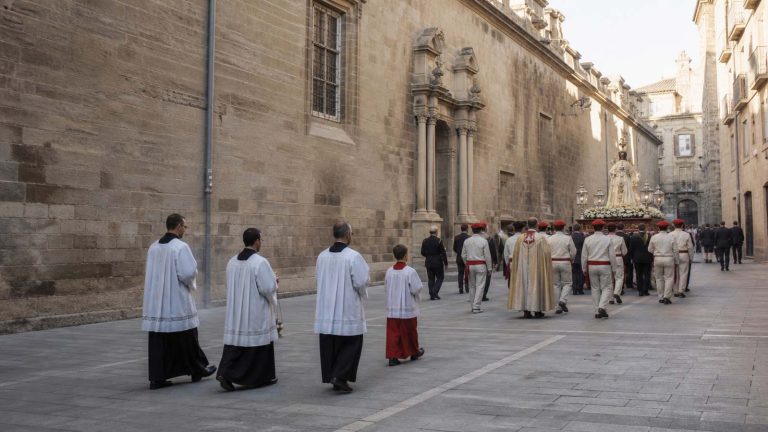
It also helps to place the Running of the Bulls within the wider calendar. The San Fermín dates provide an overview of the festival days and help you avoid reducing Pamplona to a single morning. The Chupinazo, the procession, the peñas, the music, the streets and Pobre de Mí are all part of a broader story.
Prepare for the morning rather than improvising
A simple plan makes a big difference. Decide in advance where you want to watch the Running of the Bulls and how you will get there. Check planned closures and avoid relying on a last-minute journey through the centre. If your group separates, agree beforehand where to meet once the run is over, away from the route and without obstructing people leaving the area.
After the run, leave room for the city’s own rhythm. You might have a leisurely breakfast, walk through the old town once access returns to normal or choose another event from the official programme. Avoid an impossible sequence of commitments: traffic arrangements and the intensity of the streets change during the festival, and a flexible schedule usually works better than a rigid list.
The key is to combine curiosity with caution. The Running of the Bulls can be a way into San Fermín when you watch with information, follow the rules for that year and remember that local life is best understood when you take time to observe it.
Frequently asked questions about the San Fermín Running of the Bulls
On which days does the San Fermín Running of the Bulls take place?
The usual calendar includes eight runs, from 7 to 14 July. Before travelling, always check the notices and official programme for the relevant year.
What time does the Running of the Bulls start in Pamplona?
The usual start time is 8:00 am. The route and access points are organised beforehand, so check the official instructions and allow enough time to reach your chosen viewpoint.
How long is the Running of the Bulls route?
The official route is 848.6 metres long, running from the Santo Domingo corrals to the bullring through Pamplona’s old town.
Can you see the entire Running of the Bulls from a balcony?
No. A balcony offers a view of a particular section; visibility depends on its position, height and orientation. Before requesting a proposal, ask about the exact location and applicable conditions.
What is the difference between the Encierro and Encierrillo?
The Encierro is the morning run from Santo Domingo to the bullring. The Encierrillo is the previous evening’s transfer between the Gas and Santo Domingo corrals. They are different events with different arrangements.