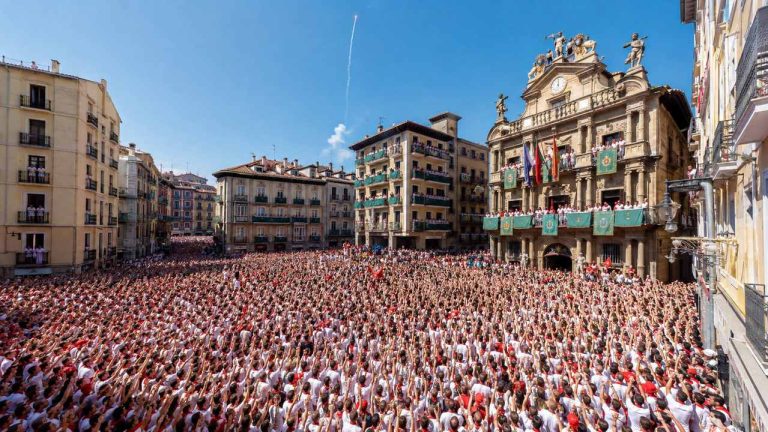
San Fermín peñas are among the most visible expressions of Pamplona’s collective life in July. They are recognised by their blouses, banners, accompanying music and way of inhabiting the street. But reducing them to groups that simply animate the festival would miss the point. Peñas belong to a popular culture with history, its own rules, friendships and a very specific role in the atmosphere of San Fermín.
For a first-time visitor, meeting a peña can feel intense: a large group moves to the rhythm of a charanga, singing, talking and bringing together people of different ages. The key is to observe before interpreting. They are not a performance hired for visitors, but associations and communities who live the festival from within. Understanding this changes the experience from looking at something picturesque to recognising one of San Fermín’s liveliest expressions.
What is a San Fermín peña?
A peña is an association of people linked by friendship, festival participation and a shared identity. Each has its own name, history, distinctive colours or blouse, symbols and ways of being present during the year and especially during San Fermín. Some began decades ago; others have evolved alongside the city and the generations that sustain them.
Their role is not limited to walking through streets. Peñas take part in Pamplona’s social and cultural life, organise activities, maintain meeting places and preserve a way of understanding the festival based on community. Pamplona City Council describes their importance clearly: without them, the music, spontaneity and much of the critical and participatory spirit of San Fermín’s streets would not be understood.
This collective dimension matters. A peña is not a brand or a tourism product, nor is it a homogeneous group. Different ages, occupations and personal histories coexist within it. What connects members is belonging to a shared project and a way of relating to the city. For that reason, peñas should be described respectfully and never as caricatures.
Music, charangas and the rhythm of the street
Music is one of the peñas’ most recognisable traits. Charangas accompany their routes and give streets a rhythm that changes according to the hour, place and moment of the festival. It is not only about volume or celebration. Music gathers people, gives orientation and creates shared space. Sometimes you hear it before you see the group; at other times, a corner or square becomes a small collective meeting point for a few minutes.
The best way for a visitor to experience this is to leave room. Do not block the route, try to cross the middle of a compact group or treat members as scenery for photographs. Watch from the side, listen and accept that the route may change. San Fermín has moments of great density and quieter ones; the experience improves when you adapt to the city’s real rhythm.
This music connects with other traditions. Gaitas, txistus, dianas and songs create a distinct soundscape. Exploring these nuances through Pamplona’s culture and local life reveals a festival far wider than its most widely shared events.
Banners: humour, memory and a critical voice
Peña banners are another identifying feature. They often combine illustration, humour, social commentary and irony. They are not simply decorative objects: they concentrate a popular way of looking at current affairs and taking part in public conversation. Reading them requires context because references may be local, political, cultural or internal to the city itself.
Visitors do not need to understand every reference to appreciate their role. It is enough to recognise them as part of an expressive tradition. Before photographing or sharing them, read them carefully and avoid taking a phrase out of context. Irony can be complex, and what looks anecdotal often belongs to a wider local debate.
Peñas therefore show that San Fermín is not a uniform festival. There is celebration, but also identity, humour and critical capacity. This mixture explains why their presence remains central and why Pamplona’s streets in July cannot be understood without them.
How to approach peñas respectfully
You do not need to belong to a peña to enjoy the atmosphere they create. The main recommendation is simple: do not invade. Observe from a reasonable distance, follow the street’s flow and remember that their routes are not organised for tourist consumption. If you are travelling in a group, agree on a meeting point so you do not stop in passageways. With children, explain that a charanga can be loud and that a more open place is better for watching.
It is also useful not to confuse participation with imitation. Wearing white and red is common at San Fermín, but wearing a peña blouse or symbol without belonging to it can feel artificial. Authenticity cannot be bought; it is shown through curiosity, listening and respectful behaviour.
The San Fermín guide is a useful starting point for understanding how peñas relate to other festival moments. The Running of the Bulls, the Giants’ troupe, the procession and street activities are part of one whole; each has its time and its code.
Beyond the festival: associations that sustain city life
Talking about peñas only in July leaves out an important part of their reality. Many maintain social and cultural activity throughout the year. This continuity shows that they are not temporary scenery, but associations linked to city life. Understanding that helps visitors look at San Fermín with fewer clichés: the intensity of a few days rests on relationships, places and memories that exist throughout the calendar.
For further context, consult Pamplona City Council’s page on peñas. It is an institutional, non-commercial source. For activities or routes in a particular edition, always check the current official programme.
Frequently asked questions about San Fermín peñas
What is a San Fermín peña?
It is a festive and social association formed by people who share identity, activities and participation in Pamplona’s life, especially during San Fermín.
Do peñas exist only during the festival?
No. Many have associative, cultural or social activity throughout the year. San Fermín is when their presence becomes most visible in the streets.
What are charangas?
They are musical groups that accompany peñas and bring a festive rhythm to their routes. They are an essential part of the city’s July soundscape.
Can I follow a peña as a visitor?
You can observe and share public space respectfully, without blocking its route or trying to join the group. The best attitude is to accompany from the margins and follow the street’s rhythm.
Why do peñas carry banners?
Banners express humour, memory and social commentary. They are a graphic tradition of peñas and often contain local or current-affairs references.